
The Old Stone Age, or Palaeolithic, began around 850,000 to 800,000 years ago in Britain, when the first humans arrived. Very little is known about these first occupants, but what we can say for certain is that they were a different species to modern humans, with Homo antecessor being a possible candidate. This long timespan included four warm periods (interglacials), interspersed by longer, cold Ice Ages (glacials). People were only able to live in Britain towards the end of the cold periods and during the warm periods, moving further south when necessary. Fortunately for them, this was easier than it would be today because Britain was connected to the Continent by a land bridge for much of the Palaeolithic, which now lies underneath the North Sea and the English Channel due to sea level rise over time. Neanderthals (Homo neanderthalis) arrived across this land bridge around 400,000 years ago, followed by the first modern humans (Homo sapiens) as late as 40,000 years ago. They were nomadic (roaming) peoples, travelling in small family bands, who made flint tools for hunting and survival.
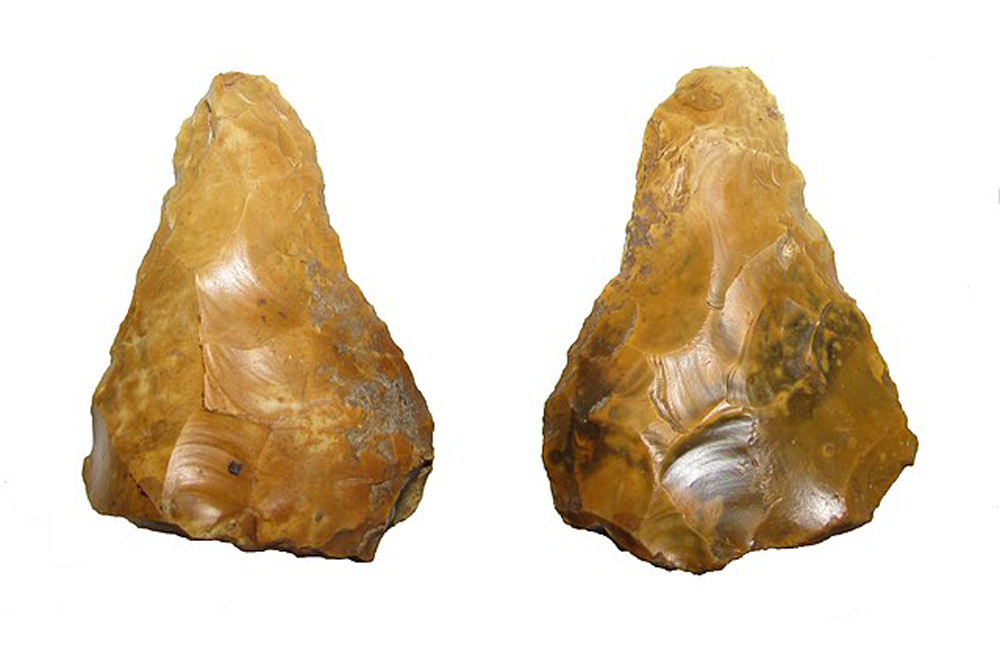
Palaeolithic flint tools, including ancient hand-axes, have been found near Chilmington Green, mainly recovered from river gravels.
Image below – An example of a Palaeolithic hand axe.